
RADIUS OF HOLLOWS GUIDE
Skate sharpening hollows (also called Radius of Hollow or RoH) refer to the slight concave curve ground into the bottom of your ice skate blade. This creates two distinct sharp edges (inside and outside) with a groove in the middle, allowing the blade to bite into the ice for control while still gliding.
Without a hollow (completely flat), your skates would be slippery and hard to turn or stop. A deeper hollow gives more "bite" (grip) but more drag (slower glide and more leg effort). A shallower hollow gives better glide and speed but less grip, making quick stops and tight turns harder.
How Hollows Are Measured
Hollows are typically measured in fractions of an inch (e.g., 3/8", 1/2", 5/8", 3/4").
Smaller number = deeper hollow (more curved groove, sharper bite into ice).
Larger number = shallower hollow (flatter groove, smoother glide).
Common starting points range from 3/8" (quite grippy) to 1" (very glidey).
Factors That Influence Your Ideal Hollow
Your best hollow depends on:
Body weight: Heavier skaters press the blade deeper naturally, so they often prefer shallower hollows to avoid feeling "stuck."
Skill level: Beginners benefit from more forgiveness and glide.
Position/style (in hockey): Forwards need agility, while others prioritize speed.
Ice conditions: Harder ice needs more bite; softer ice needs more glide.
Personal feel: Experiment—skate on different hollows and note if you feel planted, slipping, or tired.
Hockey Players: Recommendations by Position, Size, and Skill
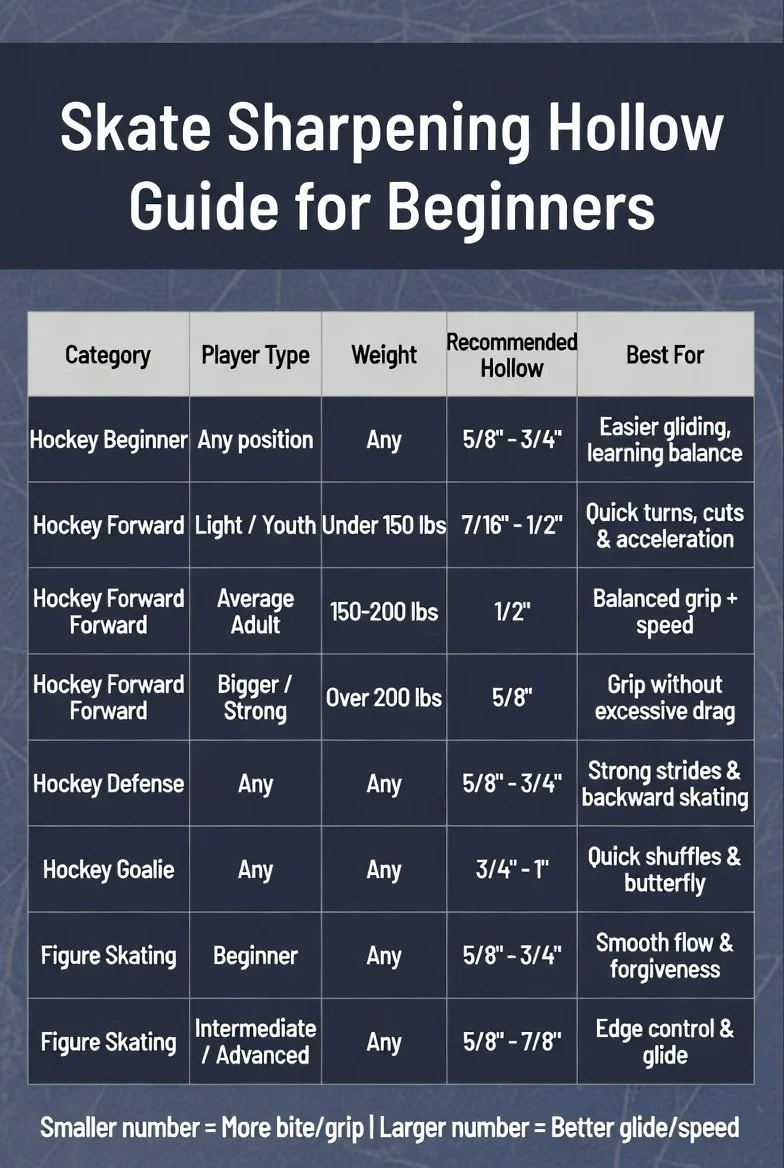
Here's a beginner-friendly breakdown for hockey:
Forwards (need quick turns, acceleration, edge work):
Smaller/lighter players or youth: Often 1/2" or even 7/16"–3/8" for extra bite to help with quick cuts and stops.
Average adults: 1/2" is a popular starting point.
Bigger/stronger players: 5/8" to balance grip with speed.
Defensemen (need powerful strides, backwards skating, stability):
Tend to like slightly shallower than forwards (e.g., 5/8" or 3/4") for better glide over long shifts and strong pushes.
Heavier players especially benefit from shallower hollows to conserve energy.
Goalies:
Usually very shallow (3/4" to 1" or even flat-bottom variants) because they prioritize quick lateral movement, butterfly drops, and not getting "stuck" while shuffling. Too much bite can hinder their style.
Player Size Guidelines (Rough Starting Points):
Under ~130–150 lbs (kids/youth/light adults): Deeper hollow like 1/2" or 7/16". Your lighter weight means you need the extra curve to dig in effectively.
150–200 lbs: 1/2" is often ideal as a versatile starting point.
Over 200 lbs: 5/8" or shallower. Your weight provides natural pressure, so deeper hollows can cause excessive drag, chattering edges, or knee strain.
Skill Level Tips:
True beginners: Shallower hollow (5/8"–3/4") for easier gliding and learning balance/stride without the blades catching too aggressively.
Intermediate: 1/2" is a sweet spot for most recreational players—good mix of control and speed.
Advanced/competitive: Fine-tune based on game video or feel. Many pros use 5/8"–7/8" because elite technique lets them generate power without needing extra bite.
Figure Skating Hollows
Figure skates are generally sharpened differently from hockey skates because the blades are longer, thinner, and have a different rocker (curve). Figure skaters perform precise edges, spins, and jumps, so they prioritize clean edge control over aggressive stopping.
Most figure skaters use shallower hollows than hockey players: Commonly 5/8" to 7/8" or even shallower.
Beginners in figure skating often start around 5/8"–3/4" for forgiveness and smoother flow across the ice.
Advanced figure skaters may go shallower for better glide during programs or deeper (closer to 1/2") if they want stronger edge bite for jumps/footwork.
Unlike hockey, figure blades emphasize the full blade length and toe picks, so hollow choice focuses more on edge quality than raw aggression.
Key difference: Hockey emphasizes quick stops/starts and physical play → often deeper hollows. Figure skating emphasizes artistry, sustained edges, and flow → shallower hollows.
Final Advice for Beginners
Ask for a 1/2" hollow as a safe starting point for most adult hockey players (adjust based on weight/position).
Skate on it for a few sessions and pay attention: Too much drag or "stickiness"? Go shallower. Slipping on turns/stops? Go deeper.
Get sharpened regularly (every 8–20 hours of ice time) and always test new settings gradually.
This is all about personal preference and feel—there's no universal "perfect" hollow. Start conservative, experiment safely, and you'll quickly learn what helps your skating the most. Enjoy the ice!